APPs: Essential Partners in Cancer Care
☑ Quick summary
At FCS, more than 300 Advanced Practice Registered Nurses and Physician Assistants provide specialized care to support each person through every phase of treatment.
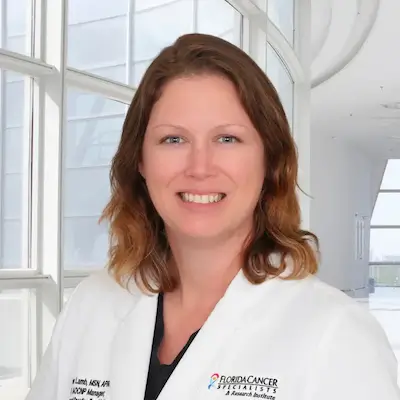
Manager of Advanced Practice Providers
Oncology APPs are not simply an extension of the physician. We diagnose, treat, prescribe, educate and advocate while collaborating with physicians to deliver exceptional care.
✦ Key highlights
- • Evaluate treatment toxicities and manage side effects
- • Order and interpret diagnostic tests and prescribe medications
- • Determine when treatment can safely continue
- • Lead survivorship clinics and symptom management programs
- • Contribute to research, quality improvement and education
✦ Did you know?
Many oncology APPs specialize further — in disease areas such as breast, gyn, lung or gastrointestinal cancers, or in therapies like radiation oncology, cellular therapies and infusion-based treatment.
APPs: Essential Partners in Cancer Care
Cancer care is never a journey patients take alone. It takes a diverse team of experts working together to support patients at every step. From physicians and nurses to pharmacists, social workers, financial navigators and many others, each brings a unique perspective and expertise that helps support each person from diagnosis through treatment and beyond.
Advanced Practice Providers, or APPs, are an integral part of our care team at Florida Cancer Specialists & Research Institute (FCS). More than 300 Advanced Practice Registered Nurses (APRNs) and Physician Assistants (PAs) across the practice have advanced degrees and specialized training in oncology. They are fully qualified to manage a wide range of care needs.
Heather Lamb, MSN, FNP, ARNP, AOCNP, FCS manager of advanced practice providers, explains, “Oncology APPs are not simply an extension of the physician. We diagnose, treat, prescribe, educate and advocate while collaborating with physicians to deliver exceptional care.”
APPs make important clinical decisions every day, evaluating treatment toxicities, managing side effects such as nausea, fatigue, infections, pain and dehydration, ordering and interpreting diagnostic tests, prescribing medications, determining when treatment can safely continue, and recognizing when a patient’s condition requires urgent intervention or hospitalization.
“We collaborate closely with physicians on complex treatment decisions, disease progression, clinical trial eligibility and changes in therapy,” Lamb says. “Our goal is to recognize problems early so patients receive the right care at the right time.”
Complementary Expertise, Shared Commitment
The physician-APP relationship is truly a partnership. While physicians bring extensive expertise in diagnosing cancer, developing treatment strategies and managing complex cases, APPs help implement those treatment plans while providing ongoing assessment, education, symptom management and continuity of care.
Strong physician-APP partnerships are built on trust, communication and mutual respect. By combining their expertise, they provide coordinated, seamless care that improves access, enhances communication and ensures timely answers and interventions. Most importantly, patients benefit from a team of experienced clinicians working together on their behalf.
Specialized Knowledge, Personalized Care
Oncology is one of the most complex and rapidly evolving areas of medicine, and oncology APPs receive specialized training that extends far beyond graduate education. Many APPs also specialize within oncology. Some focus on disease-specific areas such as breast, gyn, lung or gastrointestinal. Others develop expertise in therapies like radiation oncology, cellular therapies or infusion-based treatments. This specialized knowledge allows APPs to provide highly individualized care while serving as a consistent point of contact for patients throughout their cancer journey.
Lamb agrees that lifelong learning is essential. “APPs maintain their expertise through continuing education, participation in tumor boards, ongoing certification, review of the latest research and engagement with professional organizations such as APSHO (Advanced Practitioner Society for Hematology and Oncology) and NCODA (Network for Collaborative Oncology Development & Advancement).
“FCS is committed to APP development,” Lamb said, “providing education, mentorship, and professional growth opportunities that help providers stay current with evolving standards of care.
Expanding Roles, Greater Impact
The role of oncology APPs has grown significantly in recent years. In addition to providing expert clinical care, APPs are leaders and collaborators who help advance initiatives that improve patient outcomes and enhance the delivery of care.
APPs practice with a high degree of autonomy. At FCS, they lead survivorship clinics, symptom management programs, supportive care services and bone marrow biopsy programs, while also contributing to quality improvement efforts, research, education and leadership initiatives.
“Many people are surprised by just how much oncology APPs influence the patient experience,” Lamb says. “Beyond clinical care, we often become trusted advocates and educators, helping patients and families navigate one of the most difficult times in their lives.”
Looking ahead, the need for oncology APPs is expected to grow as cancer care becomes increasingly personalized. Advances in immunotherapy, targeted therapies, precision medicine and genomic testing continue to expand the complexity of treatment.
“I see APPs playing an even larger role in improving access, patient education and the delivery of high-quality cancer care,” Lamb says.