Hereditary Cancer Spotlight: Renal Cancer
 Quick summary
About 5% of renal cancer cases are hereditary, most often caused by a pathogenic germline mutation tied to a known inherited syndrome.
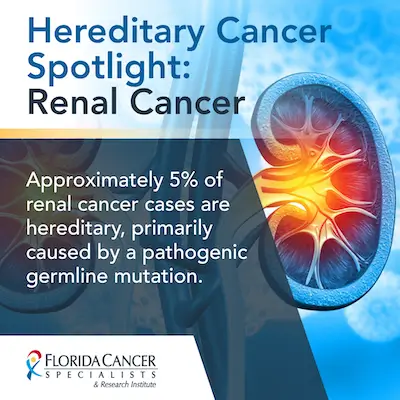
5%
of renal cancers are hereditary
300K+
new U.S. cases diagnosed yearly
✦ Did you know?
Germline testing looks at inherited DNA present in every cell — different from somatic testing, which looks only at acquired changes in a specific tumor.
 Consider testing if
- • A first- or second-degree relative has had renal cancer
- • Renal cancer was diagnosed before age 50
- • Multiple tumors in one kidney, or tumors in both kidneys
- • Diagnosis of a kidney cancer type commonly inherited
 Myriad Genetics: hereditary cancer risk
Renal Cancer
Renal cancer is the 13th most common cancer with over 300,000 new cases diagnosed per year in the United States. While a majority of renal cancers are sporadic, approximately 5% of renal cancer cases are attributed to inherited mutations with strong family history often associated with hereditary syndromes, including hereditary leiomyomatosis and renal cell cancer (HLRCC); von Hippel-Lindau disease (VHL); Birt-Hogg-Dubé syndrome (BHD); Tuberous Sclerosis Syndrome; and hereditary papillary renal cancer (HPRC).
Genetic testing for key germline variants is essential to determine if a patient has a hereditary renal cancer syndrome and therefore an increased risk of developing renal cancer. Germline cancer testing identifies inherited gene changes in DNA that are present in every cell of the body and can be passed from a parent to a child. This differs from somatic testing which looks for acquired changes that occur in a specific tumor after birth. Identifying a pathogenic germline variant associated with renal cancer syndromes can help prevent the onset of disease through increased surveillance. The type of imaging used for monitoring, the frequency of imaging, and the age of initiation varies by syndrome. In individuals who have already developed cancer, the identification of a germline variant assists in disease management and treatment. Individuals with a pathogenic variant require more frequent screening and monitoring methods, as well as family testing to determine if at-risk relatives have inherited the variant.
Genetic testing for hereditary renal cancer should be considered when there is:
- A significant family history of renal cancer, i.e. > first- or second-degree relative with RCC.
- Onset of renal cancer at an early age or under age 50.
- Multiple tumors in one kidney or bilateral tumors.
- A diagnosis of a type of kidney cancer that is commonly inherited.
For more information on genetic testing for hereditary renal cancer and related syndromes visit the links below:
The FCS Geneticists are available for clinical support: Dr. Jennifer Gass, Dr. Katy Phelan, Dr. Jeanine Ruggeri
References
- Northrup BE, Jokerst CE, Grubb RL 3rd, Menias CO, Khanna G, Siegel CL. Hereditary renal tumor syndromes: imaging findings and management strategies. AJR Am J Roentgenol. 2012 Dec;199(6):1294-304. doi: 10.2214/AJR.12.9079. PMID: 23169721.